Train Your Nervous System. Transform Your Practice.
Yet performance happens through a body.
Pressure changes breathing, muscle tone, attention, perception, movement and our capacity to connect. Mobilisation can sharpen performance or tip into overdrive. Protective responses can appear as hesitation, collapse or disconnection. Flow, play, rest and readiness each have their own embodied organisation.
Somatic Performance Enhancement (SPE) is a trauma-informed, nervous-system-based professional training for people who work with human beings under pressure.
It brings somatic psychology into direct conversation with performance: helping practitioners understand how nervous systems organise around challenge, threat, effort, recovery and relationship, and how to work skilfully with what emerges.
Whether you are a psychologist, coach, therapist, bodyworker or high-performance professional, you will learn to:
Read nervous system patterns as they unfold in performance and practice
Understand activation, freeze, recovery, play and flow as embodied states
Work with interoception, movement, touch and relational processes safely and intentionally
Develop greater discrimination about when to mobilise, stabilise, deepen, pause or support completion
Use your own embodied presence as part of skilled professional practice
SPE develops the capacity to see performance through the body - and to respond to what you find there.
Most of us working in high-pressure environments were trained to think our way through intensity.
Who it’s for
You work with people who are expected to function under pressure.
They may be athletes preparing to compete, leaders carrying responsibility, medics making difficult decisions, performers stepping into scrutiny, or professionals whose work repeatedly asks something significant of their bodies and nervous systems.
You may already understand performance psychology, trauma, coaching, therapy, movement or rehabilitation. You want to become more fluent in what happens beneath the thoughts, behaviours and strategies you encounter.
SPE is designed for professionals who want to understand the embodied dynamics of performance and develop the capacity to work with them.
The training is particularly relevant for:
Sport and performance psychologists
Psychologists, psychotherapists, counsellors and psychiatrists
Coaches, facilitators and educators
Physiotherapists and allied health professionals
Somatic practitioners, movement professionals and bodyworkers
Professionals working in elite sport, leadership, healthcare, performing arts and other high-pressure environments
Supervised trainees developing their practice in these areas
You do not need previous somatic training. Curiosity about the body, willingness to participate experientially, and an appropriate professional context in which to integrate the learning are enough to begin.

Why Somatic Performance Enhancement?
High performance places unusual demands on the nervous system.
Performers repeatedly move between anticipation, mobilisation, intense effort, uncertainty, pain, recovery, connection and rest. Their capacity to navigate those shifts influences how they experience pressure and how effectively they can respond to it.
Previous experiences also travel with us into performance environments. Bodies learn. They anticipate. They protect. They develop highly effective adaptations to the environments in which they have learned to perform.
Sometimes those adaptations become part of what makes someone exceptional.
Understanding this complexity requires more than a vocabulary of regulation and dysregulation. It requires us to ask what a particular nervous system is doing, what purpose that response may serve, what the environment is demanding, and what might support greater capacity and flexibility.
This is the territory of Somatic Performance Enhancement.
SPE brings together somatic psychology, trauma theory, nervous system science and performance practice to provide a framework for understanding the performer as an embodied, adaptive system.
Across the training, you will explore activation and mobilisation, freeze and shutdown, play and flow, recovery and rest, sensory awareness, touch, relationship and co-regulation.
The emphasis throughout is on discrimination.
What does this nervous system need here? More activation? Greater support? Movement? Stillness? Connection? Space? Completion? What changes when the performance demand changes? What happens in your own body as you try to help?
Somatic skill develops through experience: sensing, tracking, experimenting, receiving feedback and learning alongside other nervous systems.
That is why SPE is live, relational and experiential.
Conceptual learning is repeatedly brought back into the body and into the realities of performance practice. The aim is to develop practitioners who can think somatically, perceive more of what is happening in front of them, and respond with greater precision.
What Graduates of SPE Level 2 are Saying
“On a professional level? 100% On a personal level? 101% I learnt a lot about SPE, including the theory behind it, what it looks like in a session, what it feels like working in this approach, but perhaps even more importantly, through the experiential exercises, I learnt a huge amount about myself, the relationship between my mind and body and how I connect with others. I experienced feeling seen and understood as a Sport Psychologist maybe for the first time in my life. I left the course a different person.”
“I don't know how we are not taught about this during our training. It is the most important and meaningful CPD I've been to in 10 years and it is delivered beautifully.”
“It's impacted my whole philosophy, how I think about providing support and who I want to provide support for the most. SPE is an approach that resonates deeply with me. It's given me a greater understanding of what happens "the neck down" and how to work with that. Since I've been integrating SPE into my practice, I've felt more authentic than ever.”
“This workshop should be compulsory for everyone who works with high performers.”
“SPE utilises the body's wisdom to create sustainable performance. It is particularly helpful for those individuals who have learnt to always keep going, to push through and be resilient at the expense of their own well-being.”
“Cancel all of your plans on the weekends SPE is running.”
Real
〰️
Change
〰️
Happens
〰️
Below
〰️
The
〰️
Neck
〰️
Real 〰️ Change 〰️ Happens 〰️ Below 〰️ The 〰️ Neck 〰️
Course Structure
Somatic Performance Enhancement is taught progressively.
Level 1 provides the conceptual and experiential foundations. Level 2 develops these foundations through sustained in-person practice, application and integration. Level 3 will provide advanced training for practitioners wishing to deepen their work further.
4 in-person weekends + 3 online integration labs | 61 live contact hours
Level 2 is where somatic understanding becomes embodied practice.
Across four weekends, participants progressively develop their capacity to recognise, experience and work with different forms of nervous system organisation. Mornings combine conceptual teaching, discussion and demonstration. Afternoons move increasingly into experiential learning, partner and group practice, movement, observation and reflection.
The training follows a developmental arc across four weekends:
Weekend 1 - Foundations
29-30 May 2027 | London
Develop the sensory and relational foundations of somatic practice. Learn to track embodied experience, recognise nervous system organisation and begin working with resources, attention and presence.
Integration Lab 1
27 June 2027 | Online, 3-6pm
Weekend 2 - Activation & Play
24-25 July 2027 | London
Explore mobilisation, energy, action, play and performance. Develop greater discrimination around activation and learn how the body prepares to meet challenge, intensity and opportunity.
Integration Lab 2
29 August 2027 | Online, 3-6pm
Weekend 3 - Freeze & Rest
25-26 September 2027 | London
Explore protective responses, freeze, shutdown, stillness and recovery. Develop ways of staying with experiences that require time, support and careful pacing while considering their implications within performance environments.
Integration Lab 3
24 October 2027 | Online, 3-6pm
Weekend 4 - Touch & Integration
27-28 November 2027 | London
Bring the training together through touch, relationship, co-regulation, integration and applied practice. Consolidate your developing somatic style and consider how SPE can sit ethically within your existing professional work.
In-person weekends run from 9am-5:30pm on Saturday and Sunday.
The three online integration labs create space between weekends to practise, reflect, ask questions and integrate what you are learning alongside your cohort.
Level 1: Embodied Foundations

5 hours | Live online
Level 1 introduces the foundations of somatic thinking and establishes the shared language used throughout SPE.
It explores what it means to understand performance through the body, introducing participants to the philosophical and theoretical foundations of somatics alongside direct experiential practice.
Topics include:
The philosophy and history of somatics
Embodiment and the lived body
The architecture of human experience
Interoception and sensory awareness
The felt sense
Nervous system organisation
Resources and embodied capacity
Relational and trauma-informed principles
Foundational somatic practices
Level 1 can be taken as a standalone introduction and is the entry point for practitioners wishing to continue to Level 2.
2026/27 Level 1 dates:
Sunday 1 November 2026
Sunday 2 May 2027
Click the link to book your place on Level 1
Or if you’re interested in the whole programme, register your interest here

Level 3: Advanced Somatic Performance Enhancement Training
Advanced SPE training is currently in development for launch in 2028.
Details coming soon.

Level 2: Somatic Performance Enhancement Practitioner Training

A different way of understanding performance
SPE is interested in what becomes visible when we stop treating the body as simply the vehicle carrying the performing mind.
A highly activated performer may experience extraordinary intensity, speed and drive. Another may become exceptionally skilled at containing and controlling their internal experience. Some performers disconnect from bodily signals in order to keep going. Others continually seek the conditions in which flow becomes possible. Under sufficient pressure, organisation itself can become increasingly unpredictable.
These patterns can contain both performance resources and costs.
SPE therefore approaches nervous system states with curiosity rather than predetermined ideas about which states are desirable. We explore what a pattern makes possible, what it protects against, how flexible it is, and whether the performer can move between states as their environment changes.
Over time, you will develop a richer map of the relationship between performance, protection, adaptation and capacity.
What You'll Walk Away With
A performance-specific map of the nervous system
Understand activation, protection, recovery, play and flow within the realities of high-pressure environments.
Greater nervous system literacy
Learn to recognise patterns through movement, posture, sensation, attention, energy, relationship and behaviour.
A richer somatic vocabulary
Develop language that helps clients and performers become curious about embodied experience without immediately pathologising it.
Practical somatic skills
Work with interoception, sensory awareness, movement, orienting, resourcing, pacing, touch and relational processes within the boundaries of your professional role.
Greater discrimination in complex moments
Develop your capacity to judge when someone may benefit from mobilisation, stabilisation, space, connection, rest, exploration or completion.
A more embodied professional presence
Become increasingly aware of your own responses and how your nervous system participates in the relationships you create with performers and clients.
A framework you can integrate into your existing practice
SPE is designed to sit alongside your established professional approach, giving you another way to understand and work with what is happening.
A comprehensive course manual
You will receive frameworks, theory, practices and reflective material to support your learning throughout the training and beyond.
Becoming an SPE Practitioner
Completion of Levels 1 and 2 involves 66 hours of live Somatic Performance Enhancement training: five hours of foundational Level 1 teaching followed by 61 hours of experiential Level 2 training across four in-person weekends and three online integration labs.
Graduates of Level 2 may use the title SPE Practitioner, reflecting completion of the training and sustained engagement with trauma-informed, nervous-system-aware approaches to performance practice.
SPE training complements your existing professional scope, qualifications and ethical responsibilities. It does not confer a separate clinical licence or extend an existing scope of practice.
Frequently Asked Questions
-
Trauma-informed knowledge provides an important foundation for understanding how experience can shape patterns of protection, connection and response. SPE develops the embodied and performance-specific dimensions of that understanding.
You will practise tracking changes as they happen, noticing what your own body is telling you, and adapting your pacing, presence and interventions accordingly. You will also explore how responses associated with protection can intersect with performance itself, including drive, control, risk-taking, recovery and the capacity to tolerate intensity.
-
SPE has been developed specifically at the intersection of somatics, trauma and human performance.
The training considers nervous system organisation in relation to the demands placed upon high-performing people. Calm is one possible state among many. Performance can require mobilisation, aggression, precision, play, stillness, connection, rapid adaptation and the capacity to recover afterwards.
SPE teaches practitioners to recognise these different organisations and develop greater discrimination about how and when to intervene.
-
Context is central to SPE.
Somatic work in performance requires sensitivity to timing, scope, consent, current demands and the performer's available capacity. Throughout the course, we consider how interventions can be adapted to the environment and how to judge the depth of work that is appropriate within your professional role.
-
Yes. Level 1 was specifically designed to provide the foundations required for the practitioner training.
Participants arrive with different professional backgrounds and different levels of experience with embodied approaches. The training develops progressively, with concepts introduced through teaching and then explored experientially.
-
SPE is integrative by design.
Psychologists may bring it into formulation and intervention. Coaches may use it to understand readiness, pressure and relational dynamics. Physiotherapists and bodyworkers may find it expands their understanding of the experiences already emerging through physical work.
The intention is to enrich the professional framework you already use.
-
You are part of every interaction you have with a performer.
As your awareness of your own embodied responses develops, you may begin to notice more: impulses to speed up or withdraw, shifts in breathing, tension, settling, curiosity, uncertainty, connection.
SPE treats this awareness as valuable professional information. The training helps you develop the capacity to notice these responses, remain grounded in relationship and use what you perceive thoughtfully.
-
Very.
SPE combines conceptual teaching with individual exploration, movement, observation, partner exercises, group practice and reflection. Some practices involve touch, particularly later in the training.
Choice, consent and personal agency are embedded throughout the course. Participants are encouraged to work within their own capacity and professional boundaries.
-
Performance environments continually ask bodies to adapt.
People must mobilise for competition, tolerate scrutiny, manage uncertainty, recover from effort, make decisions under pressure, move between aggression and precision, connect with others and repeatedly return to readiness.
SPE gives practitioners a way of understanding those demands through the nervous system while remaining attentive to the performer's history, environment, relationships and wider wellbeing.
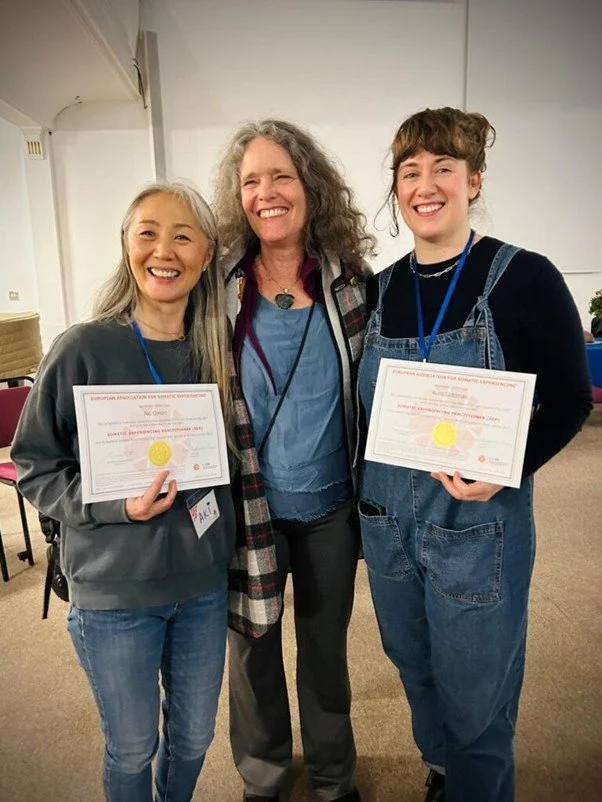
Aura and Aki met whilst training to become Somatic Experiencing® practitioners. Here they are with their teacher, the fabulous Lael Keen.
Who you’ll be taught by
Dr Aura Goldman
Dr Aura Goldman is a Chartered Psychologist, psychotherapist, practitioner sport psychologist and certified Somatic Experiencing® Practitioner specialising in performance, trauma and embodied approaches to psychological practice.
Her work spans elite sport and other high-performance environments, including work with athletes, medics, entrepreneurs, first responders and professionals operating under sustained pressure. Her approach integrates performance psychology, psychotherapy, Somatic Experiencing®, contextual-relational approaches and the science of human adaptation.
Aura developed Somatic Performance Enhancement from the meeting point between these fields: exploring how nervous systems adapt to high-performance environments and how practitioners can work with the body while retaining psychological depth, ethical care and sensitivity to context.
She is Chartered with the British Psychological Society, registered with the HCPC, and holds professional registrations and accreditations across psychology, psychotherapy and sport psychology.
Aki Omori
Aki Omori is an experienced integrative somatic trauma therapist and educator whose work spans music, physical theatre, yoga, movement and body-based therapeutic practice.
She is a certified practitioner and teacher of Body-Mind Centering®, a Somatic Experiencing® Practitioner and a certified NARM® therapist. Her training also includes a three-year diploma in Integrative Bodywork and Movement Therapy and extensive study in embodied and trauma-specific approaches.
Aki brings particular depth in movement, touch and experiential learning to SPE. She teaches nationally and internationally, co-creates trauma-informed training and maintains a weekly teaching practice in London.
Aura and Aki met while training as Somatic Experiencing® Practitioners and bring complementary backgrounds in performance psychology, psychotherapy, trauma, movement and bodywork to the training.
Course Details at a Glance
Format: Blended - online and in-person
Location: London, with integration labs online
Cohort size: Maximum 24 participants
Level 1: 5 live contact hours
Level 2: 61 live contact hours
Levels 1 + 2: 66 live contact hours
Eligibility: High-performance professionals and supervised trainees
2027 Level 2 dates
29–30 May - Weekend 1: Foundations
27 June - Online Integration Lab 1, 3–6pm
24–25 July - Weekend 2: Activation & Play
29 August - Online Integration Lab 2, 3–6pm
25–26 September - Weekend 3: Freeze & Rest
24 October - Online Integration Lab 3, 3–6pm
27–28 November - Weekend 4: Touch & Integration
Investment
Places are offered at four rates:
Trainee rate (currently in supervised training): £850
Early-career practitioner rate (completed professional training within the past 12 months): £950
Practitioner rate (qualified and self-funded): £1,250
Sponsored rate (funded by an employer or organisation): £1,600
Two concessionary places at £600 are available for participants for whom the standard rates would otherwise make the training inaccessible.
A deposit of £250 secures your place, with the remaining balance due before the start of Weekend 3. Instalment plans are available; please get in touch to discuss these.
Cancellation policy
You may cancel within 14 days of booking for a full refund.
After this period, cancellations made before 1 February 2027 are eligible for a 50% refund, less a £50 administration fee. From 1 February 2027, course fees are non-refundable.
Alternatively, you may transfer your place to the next available cohort, subject to availability and a £50 transfer fee. Any fees already paid will be credited towards the new cohort, with any difference in course fee payable.
Full terms and conditions are provided at booking.
Accessibility
We want the training to be as accessible as possible. If you have access requirements, please contact us before booking so that we can discuss how best to support your participation.
Interested in the 2027 cohort?
Booking opens 11 October 2026.
The cohort is intentionally kept small to protect the experiential and relational nature of the training, with a maximum of 24 participants.